&geometry(324x70) "Dr Gobind Bal")
Trauma & Sports Injury Surgery
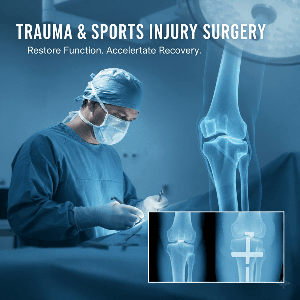
Get back to doing what you love — faster, stronger, better
Whether you've been injured on the sporting field, in an accident, or through everyday activity, a fracture or soft tissue injury can stop you in your tracks. The good news is that with expert surgical care and the right rehabilitation plan, most patients return to full function — and often perform better than before their injury.
As an orthopaedic surgeon specialising in trauma and sports injury surgery in Australia, I provide prompt, precise treatment for acute injuries and complex trauma. My approach combines advanced surgical techniques with a deep understanding of what it takes to return to sport and an active lifestyle.
Common conditions treated
Trauma and sports injury surgery covers a wide range of acute and overuse injuries, including:
Fractures — broken bones of the arm, wrist, hand, leg, ankle, and foot requiring surgical fixation
ACL tears — anterior cruciate ligament reconstruction for knee instability following sport
Meniscus injuries — repair or reconstruction of torn cartilage in the knee
Ligament and tendon ruptures — including Achilles tendon repair and ankle ligament reconstruction
Patella and quadriceps tendon injuries — repair for acute ruptures affecting knee extension
Your journey — what to expect, step by step
1. Initial consultation We begin with a thorough review of your injury, imaging, and activity goals. I'll examine the affected area carefully and explain all treatment options — surgical and non-surgical — so you can make a fully informed decision about your care.
2. Pre-operative preparation You'll complete any required health assessments and receive a tailored pre-surgery care plan. For acute trauma, this process is expedited to minimise time between injury and treatment — because early intervention often leads to better outcomes.
3. The procedure Surgical techniques vary depending on injury type and severity. I use minimally invasive approaches wherever clinically appropriate, including arthroscopic (keyhole) surgery for joint injuries, and precision fixation techniques for fractures — always with your return to function as the primary goal.
4. Hospital recovery Most patients recover in hospital for 1-3 days, though many procedures are performed as day surgery. Pain is carefully managed, and physiotherapy begins early to protect healing tissue and prevent stiffness.
5. Return to sport and rehabilitation A structured, sport-specific rehabilitation programme is central to your recovery. Regular follow-up ensures your progress is on track and your return to activity is safe, timely, and sustainable.
Recovery timeline
Week 1-2
Protecting the repair Rest, elevation, and pain management are the priority. Gentle range-of-motion exercises begin under physiotherapy guidance to prevent stiffness and support healing.
Weeks 3-8
Rebuilding strength Progressive strengthening and mobility work begins. Most patients see significant functional improvement during this phase and are managing daily activities comfortably.
Weeks 8-16
Sport-specific rehabilitation For athletes, sport-specific drills and conditioning begin once strength and stability benchmarks are met. This phase is critical for a safe, confident return to sport.
4-12 months
Return to full activity Full return to competitive sport and high-demand physical activity is achieved for most patients. The timeline varies by injury type, but the goal is always the same: a complete, durable recovery.
Questions patients most often ask me
Do I definitely need surgery for my sports injury or fracture?
Not always. Many injuries can be managed successfully without surgery, and I always explore non-operative options first. Surgery is recommended when it offers a clearly superior outcome — for example, when a fracture is displaced, a ligament is completely torn, or conservative treatment has failed to restore function. I'll be straightforward with you about what the evidence supports for your specific injury.
How soon after an injury should I see a surgeon?
As soon as possible. Early assessment is important — some injuries, particularly fractures and complete ligament tears, benefit significantly from prompt surgical treatment. Delays can complicate surgery and limit the final outcome. If you've suffered an acute injury, don't wait to seek a specialist opinion.
Will I be able to return to my sport after surgery?
For the vast majority of patients, yes. Return-to-sport rates following ACL reconstruction, meniscus repair, and fracture fixation are high when rehabilitation is completed properly. I'll give you a realistic, evidence-based timeline based on your specific injury, surgery, and individual recovery — not a generic estimate.
How long does sports injury surgery take to recover from?
Recovery time varies considerably by injury and procedure. Arthroscopic keyhole procedures often allow return to light activity within a few weeks, while major reconstructions such as ACL repair typically require 9-12 months before full return to competitive sport. I'll outline your expected recovery milestones at your very first consultation.
What are the risks of trauma or sports injury surgery?
As with any surgical procedure, risks exist — including infection, bleeding, nerve or vessel injury, stiffness, and failure of the repair. These complications are uncommon, and every aspect of your surgical care is designed to minimise them. A full, transparent discussion of risks and benefits is a standard part of every pre-operative consultation.
What is the difference between arthroscopic and open surgery?
Arthroscopic (keyhole) surgery uses small incisions and a camera to treat joint injuries with minimal disruption to surrounding tissue, resulting in faster recovery and reduced scarring. Open surgery involves a larger incision and is used when more complex reconstruction or fixation is required. I'll recommend the most appropriate technique for your injury and discuss the reasoning clearly.
Ready to take the next step?
A consultation doesn't commit you to anything — it simply gives you the information you need to make the right decision for your health and your recovery.